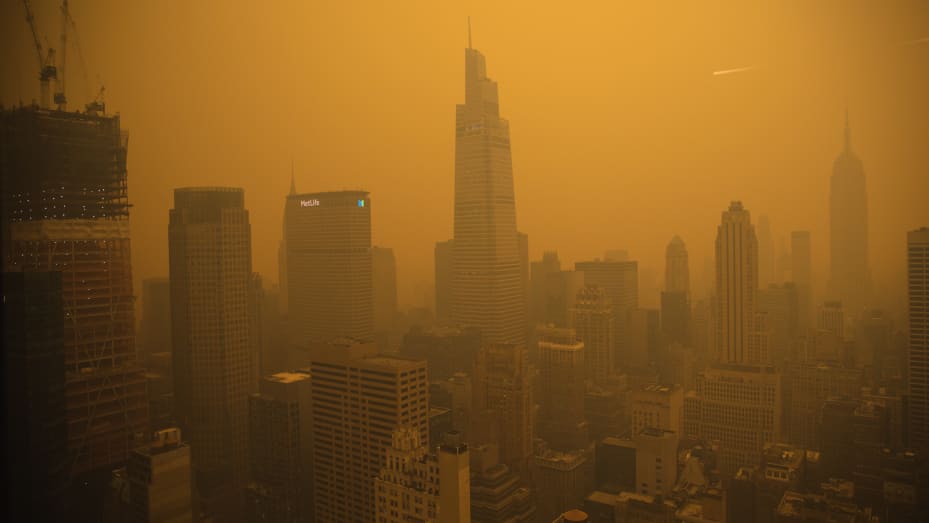
When the Canadian wildfire smoke hundreds of miles away wafted southward to New York City last week, the air quality index (AQI) went from “good” to “unhealthy for sensitive groups” to “hazardous” due the amounts of dangerous particulate matter in the air.
Those levels could have lingering effects on people similar to ones witnessed in the most polluted cities in the world — but how does the exposure compare to, say, smoking cigarettes?
If an average adult spent an 8-hour work shift outdoors in Bushwick, Brooklyn on June 7, the peak period when the skies turned orange, then they were exposed to the equivalent of smoking 30 cigarettes.
A similar shift near Queens College was worth 35 cigarettes. Staten Island’s Port Richmond was filled with 21 cigarettes worth of exposure during the peak. As Gothamist reported, several delivery workers, construction crews, street vendors and gas station employees toiled in this orange air.
Those cigarette tallies are based on a popular equation crafted in 2015 by researchers at the University of California Berkeley that equates levels of particulate matter smaller than 2.5 microns (PM2.5) to cigarette smoking. It estimated that one cigarette is equivalent to an air pollution of 22 micrograms of particulate matter for every cubic meter volume of air. And apps have been built to show how a place’s AQI translates to cigarette exposure.
To calculate inhalation around NYC, Gothamist took the math one step further accounting for how much air an average healthy person breathes in every hour. Breathing in New York City air on an ordinary day has a health impact equivalent to smoking about a half to a full cigarette every day without even lighting up. This variation depends on the season, as NYC’s air quality tends to worsen in the summer heat, as explained by recent comment from the city health commissioner.
Even before the orange smog-like air arrived on June 7, AQI had begun worsening. For example, during the Yankees loss to the Chicago White Sox on June 6, the amount of airborne particulate matter during the game was more than 20 times what it was during their previous evening home game on May 26.
Baseball fans who attended the June 6 game breathed in air over the course of nine innings that was equal to smoking about five cigarettes.
“This is three to four times higher than the World Health Organization guidelines and EPA national ambient air quality standards,” said Dr. Marianthi-Anna Kioumourtzoglou, assistant professor of environmental health sciences at Columbia’s Mailman School of Public Health. “It doesn’t mean going below those standards, you’re safe – there is no safe level of pollution.”
The Yankee game scheduled for the next day was canceled due to worsening air quality. A laborer working outside near Yankee Stadium on June 7 would have inhaled the equivalent of smoking a pack of cigarettes over the course of a standard eight-hour shift.
Such exposure worsens symptoms for respiratory diseases, such as asthma, and cardiovascular conditions such as heart disease according to Kioumourtzoglou. NYC hospitals saw twice as many emergency room visits for asthma primarily the day after the orange blanket swept through, and the incidents were highest in high-poverty, Black and Latino areas. Kioumourtzoglou said she would not be surprised if final reports record an uptick in deaths.
Kioumourtzoglou said that comparing wildfire air pollution to cigarette smoking isn’t an exact science because the pollution ingredients are slightly different. The lifetime cancer risk from wood smoke is estimated to be 12 times greater than from a comparable amount of tobacco smoke. Still, she compared the health impacts of these extended circumstances to drinking at a bar before the smoking ban.
“In bars, you really couldn’t see your friends because everybody was smoking,” Kioumourtzoglou said. “That would be similar, but the difference is that if you are in a room full of smokers, you’re there for what, one, two hours and then you leave, but the [wildfire] plume stayed with us for a good three, four days.”
Cities in Asia are exposed to this kind of poor air quality regularly. In Lahore, Pakistan, one of the most polluted cities in the world, the average annual PM2.5 concentrations are close to the readings taken at the June 6 Yankees game. Several Indian and Chinese urban areas register similar annual readings.
“They are surviving in China and India,” Kioumourtzoglou said. “But imagine what this means for weekly peaks – it’s not that you cannot survive it, but it’s definitely not healthy.”
 INTELNVIRTUE